


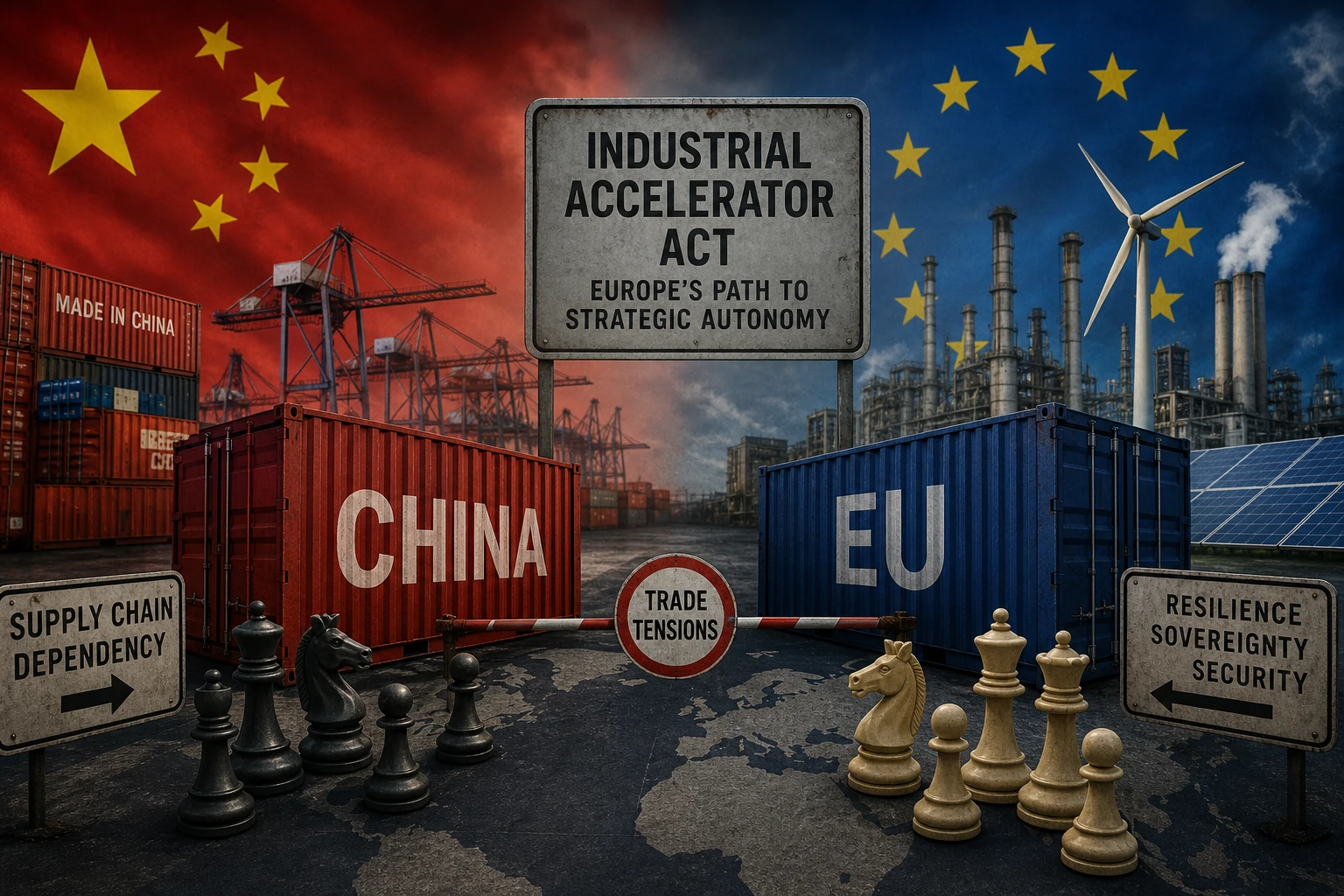
EU’s Industrial Strategy and China’s Countermeasures
In reaction to the European Union’s recently proposed Industrial Accelerator Act aimed at bolstering strategic technologies and production capabilities within Europe, Beijing swiftly issued warnings of potential retaliatory actions. This development transcends a conventional trade dispute, signaling a deeper transformation in the global economic landscape. For decades, Europe operated under the assumption that deep economic interdependence with China would ensure stability. German machinery exporters and European automotive firms benefited from extensive sales in China, while affordable intermediate goods flowed back to Europe from Chinese factories. This mutually beneficial model sustained itself for an extended period.
Shifting Competitive Landscape and Technological Rivalry
However, the balance of power has evolved considerably. China no longer serves merely as the world’s manufacturing base but has emerged as a direct technological competitor in multiple sectors, notably electric vehicles, battery technology, solar energy, and industrial electronics. European manufacturers increasingly recognize that Chinese companies are not only cost-competitive but often lead in innovation speed and scale. This competitive pressure has driven the EU to adopt more assertive industrial policies designed to strengthen strategic sectors domestically and reduce dependencies on external suppliers. While the official rationale emphasizes supply security, investment, and technological sovereignty, an implicit objective is to curtail China’s growing influence in critical industries.
Europe’s Structural Vulnerabilities and Strategic Challenges
China’s pointed reaction reflects a clear understanding of Europe’s persistent dependencies. Beyond rare earth elements and battery raw materials, Europe lacks many intermediate industrial capabilities that have largely migrated to China. Numerous supply chains remain routed through Chinese manufacturing hubs, even when the final products are marketed under European brands. This reality raises a pivotal question: Can Europe realistically rebuild strategic industries internally without incurring significant cost escalations? The era of ultra-low-cost globalization appears to be drawing to a close, compelling European policymakers to confront difficult trade-offs between economic efficiency and strategic autonomy.
Global Industrial Policies and Competitive Geopolitics
The United States and China have both intensified aggressive industrial policies, protecting key sectors, subsidizing domestic production, and embedding geopolitical considerations into economic planning. Europe’s effort to adopt a similar strategic posture arrives comparatively late and lacks the financial resources and centralized governance mechanisms characteristic of the US and China. This disparity complicates Europe’s capacity to implement effective industrial reshoring and technological development at scale.
Implications for Business and the Future of Global Supply Chains
For companies operating within this evolving environment, traditional metrics of operational efficiency no longer suffice. Supply chains must be resilient, raw material access assured, and political risk factored prominently into investment decisions. The confrontation between China and the EU should not be viewed as transient political posturing but as part of a broader trend toward economic fragmentation. This fragmentation is set to be a defining feature of the global economy over the next decade, reshaping competitive dynamics and strategic calculations across industries.
Can you afford not to expand abroad Talk to us, we’ll help you grow your business internationally.
Talk to us →