


Introduction to China’s Reusable Spaceplane Endeavor
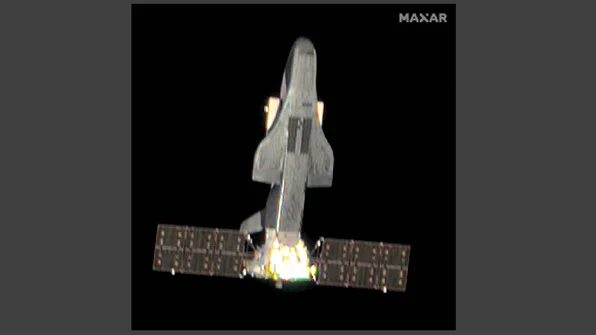
Since 2020, China has quietly launched multiple missions involving a mysterious reusable spaceplane, drawing increasing scrutiny from U.S. intelligence and defense analysts. For the first time, a high-resolution image captured by a U.S. commercial Earth observation satellite has been publicly released, providing a rare glimpse of this enigmatic spacecraft in orbit. The image, included in a recent report by the U.S. Defense Intelligence Agency (DIA), reveals a vehicle resembling a scaled-down version of the U.S. Air Force’s X-37B spaceplane, supplemented by prominent solar panels at its rear.
Comparative Analysis of U.S. and Chinese Spaceplane Programs
The DIA report highlights the technological parallels between the U.S. and Chinese efforts to develop experimental, unmanned, and reusable spaceplanes. Both programs focus on reducing the exorbitant costs associated with space access by enabling the recovery, refurbishment, and reuse of critical components such as rocket stages, payload fairings, and spacecraft modules. While the U.S. X-37B has conducted multiple missions since its inception, China has launched four such spaceplanes since 2020, with its latest mission ongoing since February 2024.
Despite the similarities, the operational details and mission objectives of these vehicles remain highly classified in both countries. The Chinese program is particularly opaque, with the DIA referring to two possible models named “Shenlong” and “Tengyun,” though no official Chinese designation has been confirmed internationally. The initial Chinese prototype was deployed in 2020 for a two-day mission, followed by a second vehicle that remained in orbit for 276 days starting in August 2022. Subsequent missions have demonstrated sustained orbital endurance, with the most recent mission approaching similar durations.
Operational Capabilities and Strategic Significance
Analysis of orbital behavior indicates that the Chinese spaceplane has demonstrated complex operational capabilities, including deploying, retrieving, and redeploying satellites during its missions. Such maneuvers suggest potential roles in satellite servicing, repair, or other in-orbit activities, although specific functions remain undisclosed. This capability mirrors aspects of the U.S. X-37B program, which, during its eighth mission launched in August 2025, reportedly tested advanced technologies such as laser communication systems and the most powerful quantum inertial sensor ever deployed in space.
The strategic implications of these developments are significant. The ability to operate reusable, unmanned spaceplanes enhances a nation’s flexibility and persistence in space, contributing to both civilian and military objectives. It also introduces new dimensions to space situational awareness, force projection, and potentially counterspace operations.
Context within Global Space and Security Competition
While China and the United States have made substantive progress in this domain, Russia’s efforts have lagged. Despite announcements of similar programs, Moscow has seen limited advancement since its sole uncrewed Buran space shuttle flight. This divergence underscores the intensifying technological competition between the U.S. and China in strategic space capabilities.
Given the inherently transparent nature of objects in low Earth orbit, the ongoing observation and analysis of these spaceplanes provide critical insights into the evolving balance of power in space. The continued refinement and deployment of such vehicles by China signal a deliberate effort to achieve parity or superiority in reusable space technologies, which may have far-reaching consequences for national security and space governance.
Conclusion
The revelation of China’s secretive reusable spaceplane program, as evidenced by the recent satellite imagery and DIA analysis, marks a pivotal development in the militarization and technological advancement of orbital assets. The convergence of U.S. and Chinese capabilities in this area reflects broader strategic competition in space, emphasizing the importance of innovation, industrial scale, and operational versatility in securing long-term technological dominance. Monitoring these programs will remain essential for understanding future trajectories in space-based defense and intelligence capabilities.
Related Analysis
Source:
HEISE
Can you afford not to expand abroad Talk to us, we’ll help you grow your business internationally.
Talk to us →