


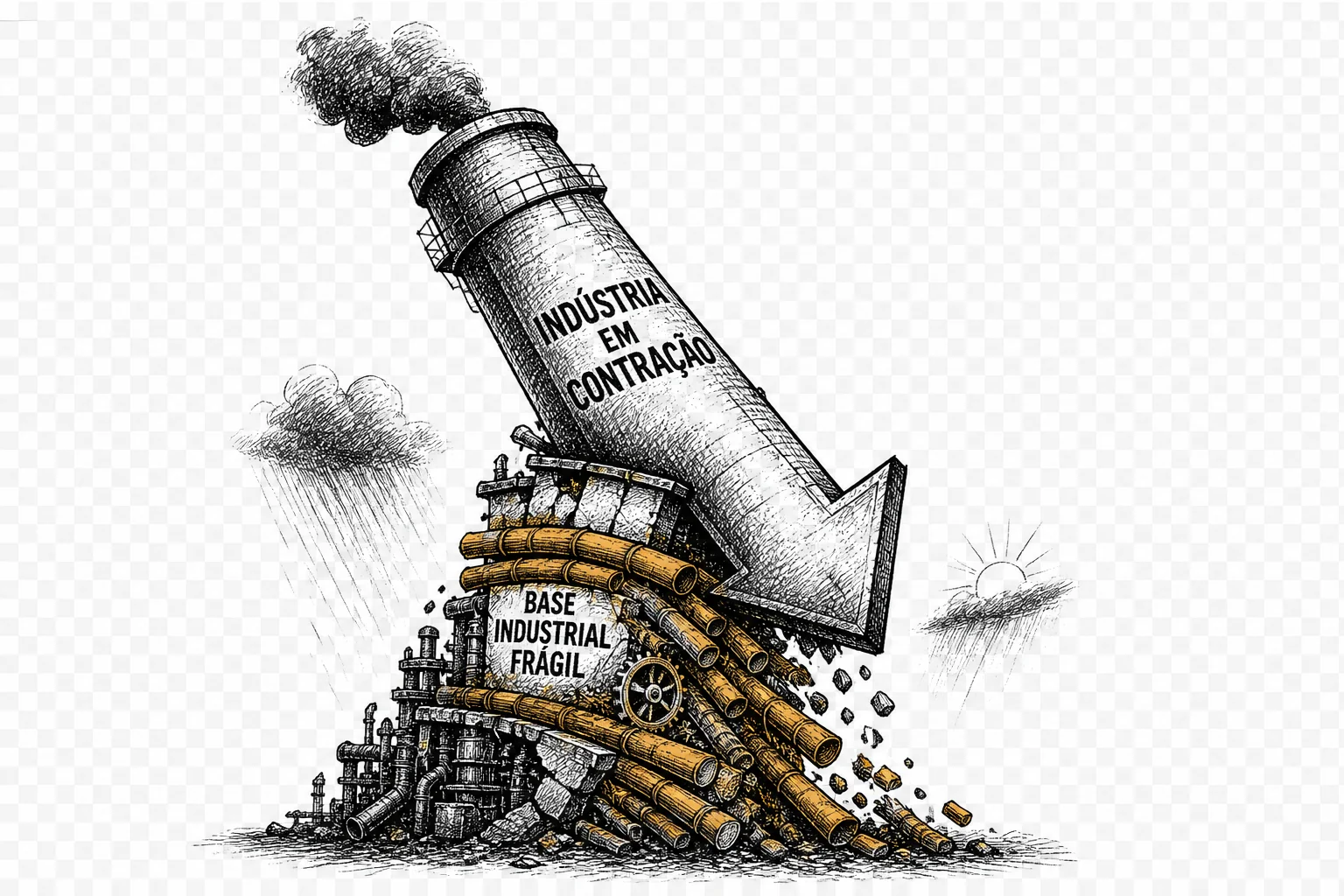
Persistent Decline in Industrial Production
Brazilian industrial output experienced a 0.8% decrease from August to September, according to the latest data released by the Brazilian Institute of Geography and Statistics (IBGE). This contraction represents the fourth decline within a five-month period, underscoring a continuing downturn in the manufacturing sector. The cumulative loss over these five months amounts to 4.1%, effectively erasing much of the 4.2% growth recorded in the first four months of the year.
Market Expectations and Annual Performance
The Ministry of Finance’s Secretariat of Economic Policy noted that the September figure fell short of market expectations, which had anticipated a more moderate 0.4% decline. Despite the recent negative trend, the industrial sector has managed a modest 0.2% increase over the past twelve months. However, analysts highlight a clear reduction in growth momentum, signaling underlying structural challenges.
Sectoral and Activity-Level Trends
Analysis by IBGE’s research analyst André Macedo reveals that the downturn was broadly distributed across the industry. Three of the four major economic categories—capital goods, semi and non-durable consumer goods, and intermediate goods—experienced declines, while durable consumer goods showed a slight increase of 0.7% in September.
Among specific industrial activities, the most significant negative impacts came from the production of coke (a coal derivative), petroleum products and biofuels, which fell by 4.2%, and food products, which declined by 1.7%. The drop in ethanol and sugar production was largely attributed to reduced sugarcane processing, a consequence of increased rainfall affecting harvest conditions.
Conversely, the extractive industries provided a notable positive contribution with a 1.7% increase, driven primarily by higher extraction volumes of crude oil, natural gas, and iron ore. This sector’s performance partially offset the broader industrial contraction.
Historical Context and Calendar Effects
When compared to September 2025, industrial production in September 2026 fell by 2.5%, marking the steepest year-on-year drop since March 2024. IBGE cautions that this comparison is influenced by calendar effects, as September 2026 had one fewer working day than the previous year, and by a relatively high production base in September 2025, when the sector grew by 2%.
Despite these fluctuations, the current production level remains 16.5% below the peak recorded in May 2011, highlighting the long-term challenges facing Brazil’s industrial sector amid evolving domestic and international economic conditions.
Related Analysis
-
Brazilian Industrial Production Declines 0.6% from July to August Amid Rising Interest Rates
-
Brazilian Industrial Confidence Declines, Extending 21-Month Period of Pessimism
-
Petrobras Market Valuation Surges Amid Rising Oil Prices and Production Gains
Source:
Agência Brasil
Can you afford not to enter the Brazilian market? Talk to us, we’ll help you succeed in Brazil.
Talk to us →