


Understanding the Concept of the World Economic Center of Gravity
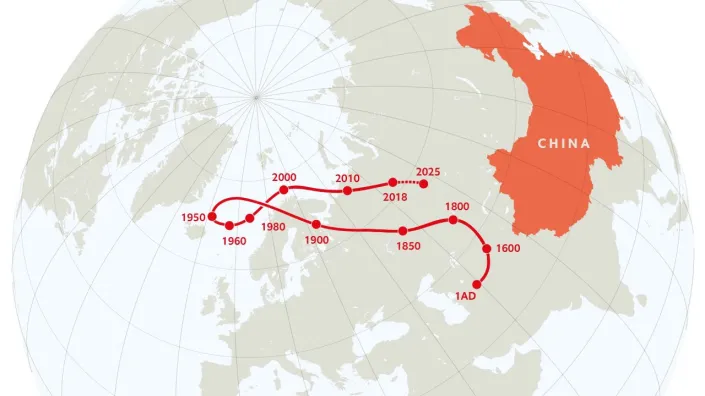
In 2011, Danny Quah, a professor at the London School of Economics, introduced a framework to analyze the spatial dynamics of global economic activity. He defined the World Economic Center of Gravity (WECG) as the average geographic location of global economic output, measured by gross domestic product (GDP) distributed across approximately 700 identified locations worldwide. This metric provides a quantitative lens to track shifts in economic power and influence over time.
Historical Trajectory of the Economic Center
Historically, the WECG has undergone significant transformations. Around the beginning of the Common Era, China and India dominated the global economy, situating the economic center in Asia. However, the industrialization of Europe and the subsequent rise of the United States shifted this center westward, placing it in the middle of the Atlantic Ocean by 1980. Japan’s rapid economic expansion in the latter half of the 20th century nudged this point northward, reflecting its emergence as a major economic power.
Recent Shifts and Future Projections
By 2008, the WECG had moved eastward to a location between Izmir and Minsk, east of Helsinki and Bucharest. This movement reflects the accelerating economic growth in Asian economies, particularly China and India. Quah’s projections suggest that by 2050, the global economic center will be situated between these two countries, marking a profound eastward realignment of economic activity.
Moreover, the horizontal trajectory of the WECG indicates a relatively stable north-south position, with latitude decreasing from 66 degrees north to 44 degrees north by 2049. This trend implies that the global economic weight is shifting towards the southern hemisphere, paralleling the eastward movement and signaling growing economic strength in southern regions.
Implications for Global Governance and Policy
The eastward shift of the global economic center has significant implications for international governance and policy frameworks. As economic power consolidates in Asia, global institutions and policymaking bodies will need to incorporate a more inclusive representation of Eastern economies. While some policy objectives, such as promoting sustained economic growth, remain constant, others—particularly those related to security, trade, and diplomatic interventions—may require recalibration to reflect the changing geopolitical landscape.
For businesses and policymakers alike, the question arises: can one afford to be absent from key Asian markets, especially China? Strategic engagement with these economies is increasingly critical for maintaining competitive advantage and understanding the evolving contours of global economic influence.
Can you afford not to expand abroad Talk to us, we’ll help you grow your business internationally.
Talk to us →