


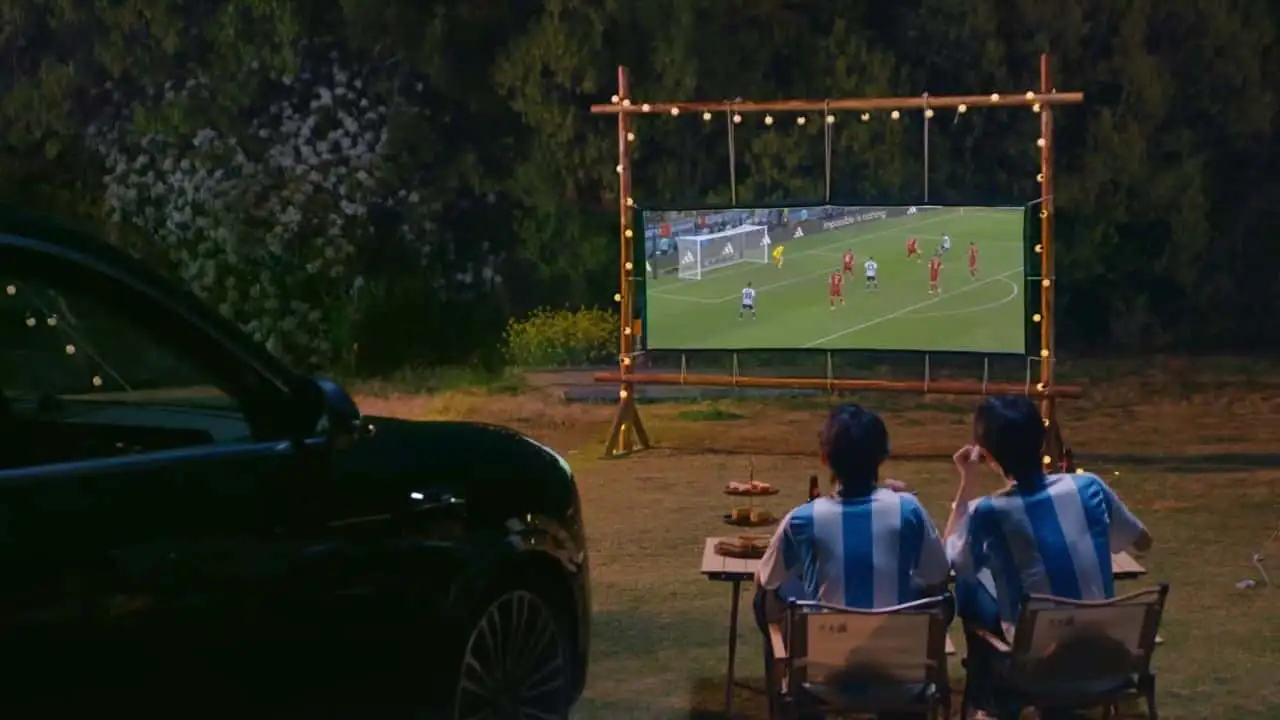
Introduction of Advanced Projection Technology in Chinese Electric Vehicles
Chinese electric vehicle (EV) manufacturers have recently unveiled a pioneering advancement in automotive lighting technology that extends beyond traditional illumination. The latest models now feature headlights capable of projecting full-color films onto external surfaces, effectively transforming nearby walls into large-scale display screens. This development represents a significant technological leap, particularly when compared to the current state of adaptive headlight systems prevalent in the United States.
Huawei’s XPixel Technology: From Illumination to Entertainment
At the Huawei Qiankun Technology Conference held during the Beijing Auto Show, Huawei introduced the latest iteration of its XPixel headlight system. Unlike conventional adaptive lighting that primarily adjusts beam patterns for safety, XPixel integrates a full-color projection capability. This system functions similarly to a large-scale projector mounted at the vehicle’s front, enabling owners to park their vehicles and display films or series on adjacent walls, thereby creating a personal open-air cinema experience.
The XPixel technology has been in development for approximately three years, with earlier versions incorporated into vehicles such as the Huawei Stelato S9. The current advancement marks a transition from purely functional lighting towards interactive entertainment and communication.
Integration with Driver Assistance and Safety Features
Beyond entertainment, XPixel headlights are deeply embedded within the vehicle’s driver assistance systems. Huawei highlights several practical applications of the technology, including the projection of guided paths to assist with lane changes, signals to pedestrians indicating safe crossing times, and interactive games designed for children, such as hopscotch. These functionalities transform the headlights into dynamic communication interfaces between the vehicle and its environment, enhancing both safety and user engagement.
Regulatory Environment and Comparative Analysis with the United States
The advancement of such technologies in China contrasts sharply with the regulatory landscape in the United States. For decades, US federal safety standards have constrained the adoption of adaptive headlight technologies, with substantial regulatory revisions only occurring in 2022. Consequently, adaptive lighting systems remain a relatively recent innovation in the US market, whereas Chinese EVs have progressed to incorporating full-color projection capabilities.
This regulatory lag has contributed to a technological disparity, underscoring the challenges faced by US manufacturers in matching the rapid pace of innovation emerging from China.
Implications for the Global Automotive Industry
The evolution of headlight technology exemplifies a broader trend within the Chinese automotive sector, where manufacturers integrate advanced features at competitive costs, often outpacing international competitors. What was traditionally a basic safety component now serves multifaceted roles encompassing display, communication, and entertainment.
This widening technological gap presents both opportunities and challenges. Consumers benefit from access to sophisticated vehicle functionalities that were once considered futuristic. Conversely, established automakers globally must accelerate their innovation cycles and navigate evolving regulatory frameworks to remain competitive.
In summary, the Chinese approach to automotive lighting technology reflects a strategic emphasis on multifunctionality and integration, positioning their electric vehicles at the forefront of automotive innovation and signaling a shift in global industry dynamics.
Can you afford not to expand abroad Talk to us, we’ll help you grow your business internationally.
Talk to us →