


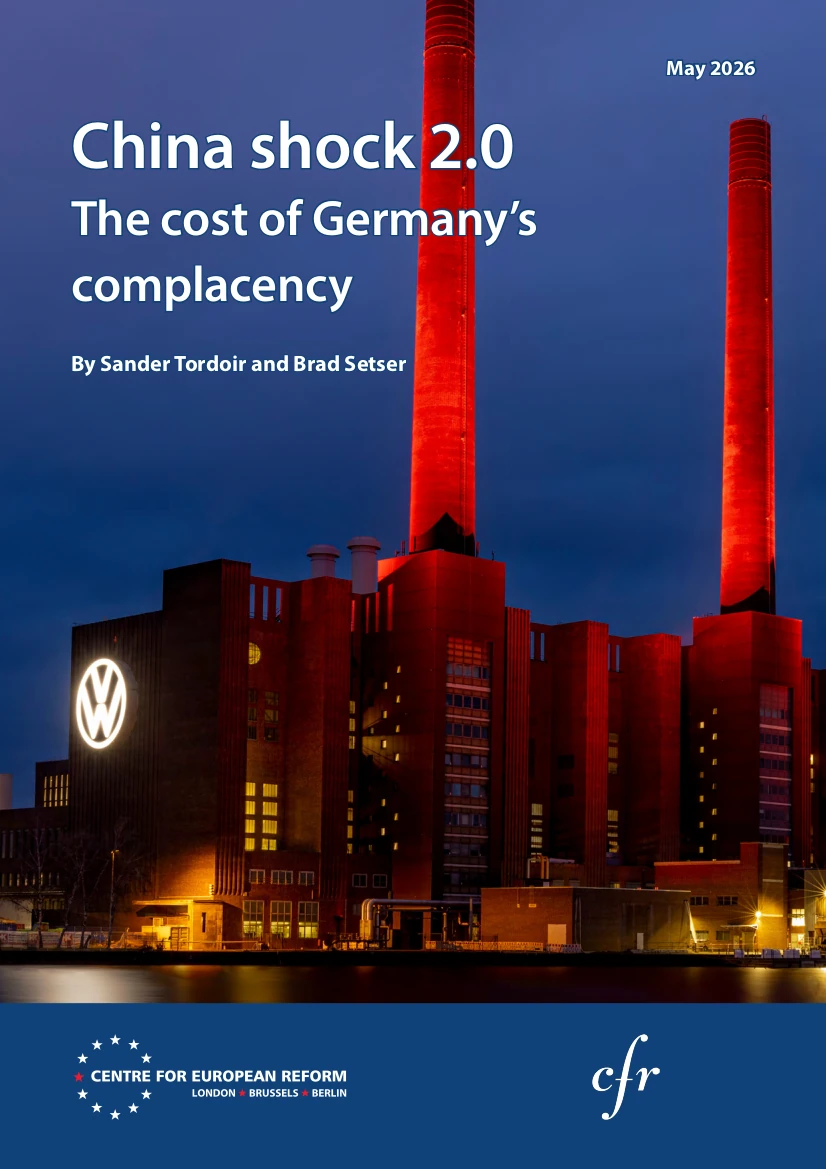
Reemergence of Chinese Export Pressure on German Industry
A comprehensive report by Sander Tordoir and Brad Setser, published jointly by the Centre for European Reform and the Council on Foreign Relations in May 2026, underscores a significant challenge confronting Germany and much of European industry. The report identifies a second wave of disruption driven by China’s expanding export capabilities, which is exerting profound pressure on Germany’s industrial base.
The German economy is currently experiencing a rare and sustained downturn. Industrial production has been declining for six consecutive years, private consumption remains subdued relative to pre-pandemic levels, and the overall GDP is approximately 6 percent below its expected trajectory. Central to this malaise is a sharp contraction in export demand, particularly linked to China.
Scale and Nature of the Disruption
Chinese export volumes have surged dramatically, with automotive exports alone meeting their annual targets by the fourth quarter of 2025. This expansion coincides with German manufacturers facing displacement not only within China but also in third-party markets and increasingly within their domestic market. Key sectors under pressure include automotive manufacturing, machinery, chemical production, aerospace, and clean technology industries—areas traditionally representing German industrial strengths.
Since late 2023, the cumulative decline in Germany’s net exports amounts to roughly 3 percent of its GDP, with further deterioration anticipated. China’s production surplus has escalated to nearly an additional one percent of global GDP, mirroring the magnitude of the original “China Shock” following China’s WTO accession in 2001. Unlike the earlier wave, this new surge targets higher-value, technologically sophisticated sectors critical to Germany’s economic positioning.
Underlying Drivers of China’s Export Dominance
The report attributes this phenomenon to three persistent factors within China’s economic framework. First, a high national savings rate coupled with weak domestic consumption, exacerbated by an ongoing real estate crisis and limited social safety nets, suppresses internal demand. Second, extensive industrial policies and subsidies, estimated at 4.4 percent of China’s GDP or about $800 billion annually, foster chronic overcapacity that necessitates export-driven offloading. Third, an actively managed and undervalued Renminbi exchange rate enhances China’s export competitiveness, with some estimates suggesting the currency is undervalued by up to 30 percent when adjusted for data irregularities.
The combined effect is a global demand absorption by China with minimal reciprocal import activity, resulting in a collapse of German exports to China and aggressive Chinese market penetration into Europe and beyond.
Lessons from the Solar Photovoltaic Sector
The report highlights the German solar photovoltaic industry as a cautionary example. Once a global leader in solar equipment manufacturing, Germany has since ceded dominance across the entire value chain to Chinese firms. Comparable competitive dynamics are now evident in automotive manufacturing—where China has become the world’s largest exporter with substantial overcapacity—as well as in machinery and clean technology sectors.
Policy Recommendations for Germany and Europe
The authors argue that Germany’s traditional reliance on market self-correction is no longer viable. They advocate for a suite of policy measures to counteract systemic distortions and protect industrial capabilities. These include strengthening and accelerating trade defense mechanisms, moving beyond slow, product-specific antidumping cases toward broader sectoral safeguards, and potentially adopting a European equivalent of the U.S. Section 301 framework to address systemic trade imbalances.
Additionally, the report calls for reinforced Buy-European industrial policies, tightening local content requirements in subsidies and public procurement to ensure European demand supports European production. Reciprocity with allied partners such as the United States, the United Kingdom, Japan, and South Korea is recommended to leverage industrial policy incentives strategically. Preparing for retaliatory measures through compensation mechanisms funded by tariff revenues and reducing critical dependencies—particularly in rare earths, minerals, and key components—is also emphasized. Finally, the authors suggest exerting diplomatic and economic pressure on China to recalibrate its currency policy and stimulate domestic consumption.
Strategic Implications for Global Enterprises
This “China Shock 2.0” extends beyond Germany, reshaping global competition within advanced manufacturing sectors. Companies engaged in European supply chains, automotive, machinery, or clean technologies should reassess their operational strategies. Diversification of production locations to reduce exposure to China-centric supply chains is imperative. Firms must also anticipate increasing trade barriers, localization pressures, and potential supply disruptions. Monitoring evolving European policies aimed at strategic autonomy and friend-shoring will be critical for maintaining competitive positioning.
The report serves as a stark warning: reliance on spontaneous market adjustments risks permanent erosion of industrial capabilities. Proactive strategic adaptation to this evolving geoeconomic environment will be essential for companies seeking to sustain technological leadership and economic competitiveness.
For stakeholders tracking global trade trends, industrial policy, and Sino-European economic relations, the full report offers valuable insights and is available through the Centre for European Reform.
Can you afford not to expand abroad Talk to us, we’ll help you grow your business internationally.
Talk to us →