


eviving Ground-Effect Flight with Modern Electric Technology

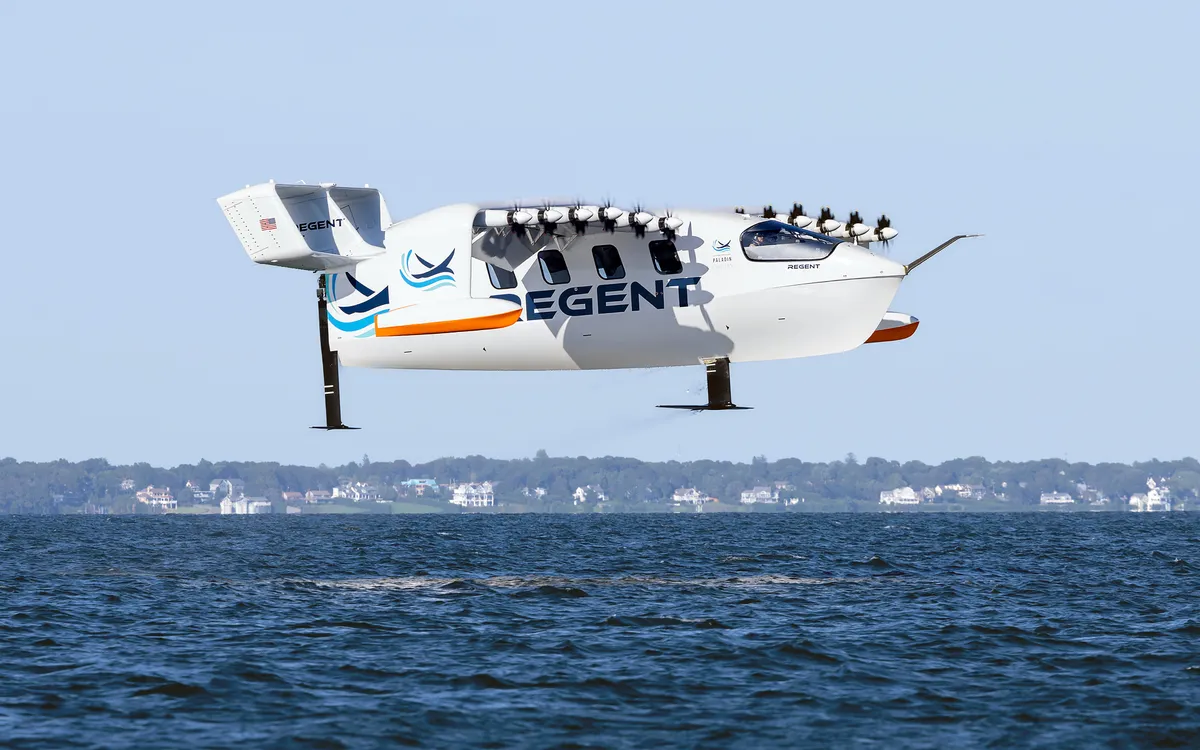
The concept of wing-in-ground (WIG) effect vehicles, first pioneered by the Soviet Union with its massive ekranoplans in the 1960s, is experiencing a technological renaissance through the efforts of Regent Craft, a Rhode Island-based company. Their Viceroy Seaglider leverages the aerodynamic principle where flying close to the water surface reduces drag and increases lift, enabling efficient, low-altitude flight that requires less propulsion power than conventional aircraft.
Measuring 16.8 meters in length and boasting a nearly 20-meter wingspan, the Viceroy is the largest electric WIG vehicle to have carried passengers, completing its maiden flight in September 2023. It is designed to operate seamlessly across multiple modes: floating like a boat near docks, transitioning onto hydrofoils at higher speeds, and finally taking off to glide approximately 10 meters above the water surface. This multi-modal capability positions the Viceroy as a versatile platform for coastal passenger transport, cargo movement, and defense-related missions.
Addressing the Regional Travel Gap with Practical Innovation
Regent Craft’s CEO, Billy Thalheimer, an aerospace engineer with experience at Boeing’s Aurora Flight Sciences, Blue Origin, and Virgin Galactic, identifies a strategic niche for the Viceroy in regional travel markets where distances are too long for driving yet too short to justify traditional air travel. Coastal corridors plagued by traffic congestion or limited airport infrastructure, such as routes between New York and the Hamptons or island chains like Hawaii and the Caribbean, stand to benefit from this new mode of transport.
The Viceroy’s electric propulsion system comprises a dozen motors powered by a battery pack equivalent to that of five Tesla Model S vehicles, delivering speeds up to 290 kilometers per hour and a range of 290 kilometers. Its passenger capacity of 12, plus two captains, exceeds that of most private helicopters and small planes, while offering a larger payload than typical eVTOLs. These specifications underscore the Seaglider’s potential to provide faster, more efficient coastal connectivity.
Regulatory and Operational Advantages Over eVTOLs
One of the Viceroy’s notable strategic advantages lies in its regulatory classification. Unlike eVTOLs, which are subject to Federal Aviation Administration (FAA) oversight and face unresolved certification and airspace integration challenges, WIG vehicles currently fall under maritime jurisdiction, regulated by the U.S. Coast Guard. This distinction could accelerate deployment timelines by bypassing some of the regulatory impediments that have slowed eVTOL adoption.
The FAA is mandated to collaborate with the Coast Guard to clarify regulatory frameworks for WIG craft, but the existing maritime classification allows the Viceroy to operate under standards similar to those for ships. Consequently, Viceroy pilots require certification as master mariners rather than extensive pilot training, potentially lowering operational costs and expanding the pool of qualified operators.
Technological Sophistication Enhances Safety and Usability
Regent’s manufacturing facility in North Kingstown, Rhode Island, features advanced simulation technology that demonstrates the Viceroy’s ease of operation. Sophisticated control algorithms simplify pilot input to speed and directional control, with near-autonomous transitions between floating, foiling, and flying modes. This automation addresses historical challenges faced by Soviet-era ekranoplans, which were difficult to handle during low-altitude flight and takeoff phases.
The integration of hydrofoils reduces water drag during takeoff, smoothing the transition from waterborne to airborne operation. Redundant electric power systems and modern avionics enhance reliability and safety, enabling the craft to operate in sea conditions with waves up to 1.5 meters high. Moreover, the Viceroy’s low flight altitude necessitates constant situational awareness, supported by cameras and sensors to detect maritime traffic and ensure navigational safety.
Expanding Applications and Strategic Implications
Beyond passenger transport, Regent is developing an uncrewed variant, the Squire Seaglider, supported by U.S. Marine Corps contracts. This smaller WIG vehicle aims to provide mobile communications support for naval operations and other specialized missions, illustrating the technology’s dual-use potential.
The Viceroy’s ability to operate without reliance on traditional airports or runways, needing only water for landing and takeoff, offers significant operational flexibility. This characteristic could prove advantageous in military logistics, disaster response, and remote area connectivity, enhancing resilience and strategic mobility along coastal regions.
Outlook for Commercial Production and Market Penetration
With over $340 million in investment funding and a reported $10 billion order backlog, Regent Craft plans to commence commercial production of the Seaglider by late 2027. Partnerships with operators such as The Twenty Five and maritime firm Hornblower indicate a focus on the U.S. East Coast, particularly the Northeast and Florida, as initial deployment zones.
The emergence of electric WIG vehicles like the Viceroy represents a convergence of aerospace innovation, sustainable energy use, and maritime regulatory frameworks. As regional transportation demands evolve, this technology could redefine coastal mobility, offering a competitive alternative to both ferry services and short-haul aviation, while advancing the United States’ leadership in next-generation electric flight systems.
Source:
IEEE
Can you afford not to expand abroad Talk to us, we’ll help you grow your business internationally.
Talk to us →