


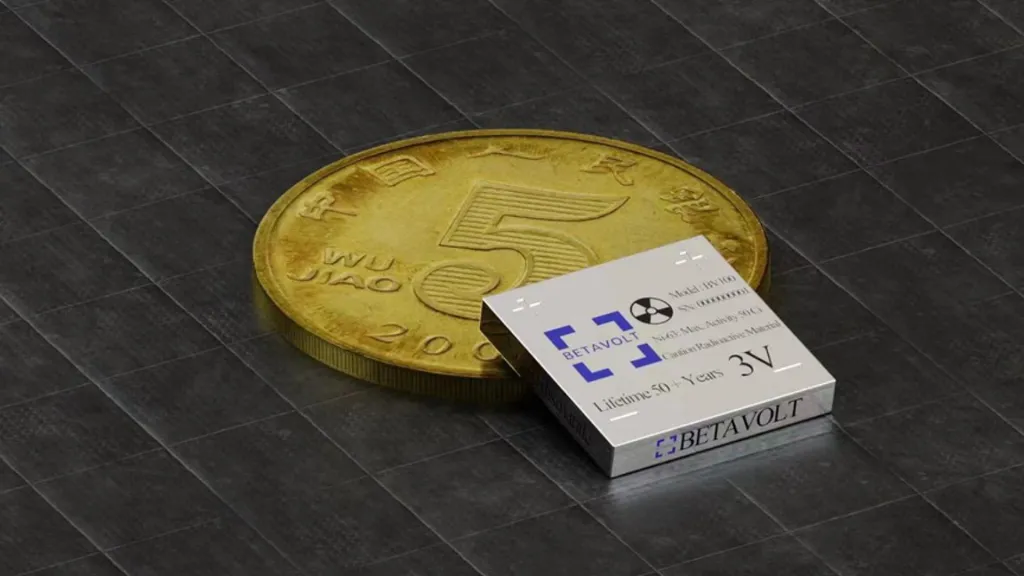
For decades, the fundamental limitation of batteries has been their finite energy storage capacity. Whether powering smartphones, electric vehicles, satellites, or remote sensors, batteries eventually deplete and require recharging or replacement. This constraint has driven entire industries to improve battery capacity, charging speed, and electronic efficiency. However, a Chinese company is now pursuing a radically different approach that could redefine energy supply paradigms.
Based in Beijing, Betavolt has introduced the BV100, a coin-sized atomic battery that leverages radioactive nickel-63 and diamond semiconductor technology to produce continuous electrical power for up to fifty years without maintenance or recharging. While media attention has often focused on the prospect of smartphones powered indefinitely, the broader significance of this technology lies in its potential applications beyond consumer electronics.
Moving Beyond Lithium-Ion Batteries
Modern society’s increasing reliance on batteries spans consumer electronics, electric transportation, and military equipment, making mobile energy a critical strategic resource. Despite advancements, lithium-ion batteries face inherent limitations, including gradual degradation, dependence on charging infrastructure, and diminished performance under extreme environmental conditions.
The BV100 operates on a fundamentally different principle. Instead of storing chemical energy, it converts the energy from the radioactive decay of nickel-63 directly into electricity through ultrathin diamond semiconductor layers. As long as the isotope undergoes decay, the battery generates power, extending its operational life from hours or days to multiple decades.
While radioisotope batteries have long powered spacecraft, remote research stations, and medical devices, Betavolt’s innovation lies in miniaturizing this technology for broader industrial deployment.
Challenges in Power Output
A significant limitation of the current BV100 model is its power output, which is approximately 100 microwatts. This level suffices for low-power sensors and specialized electronics but falls far short of the demands of modern smartphones, laptops, or electric vehicles. Industry experts emphasize that the current design supplies only a fraction of the energy required for mainstream consumer devices.
This constraint has engendered skepticism regarding the technology’s immediate applicability. Discussions often highlight that the battery is better suited as a long-term power source for autonomous systems rather than a direct replacement for conventional batteries. Betavolt acknowledges this limitation and has announced plans to develop a version delivering around one watt, a substantial improvement though still insufficient for high-energy applications.
Strategic Government Interest
The most impactful applications of this technology are unlikely to be in consumer electronics. A battery capable of operating maintenance-free for decades could revolutionize sectors reliant on long-term autonomous power. This includes sensors monitoring pipelines, bridges, railway networks, shipping containers, military installations, satellites, and environmental systems, all of which require reliable energy sources with extended operational lifespans.
Governments worldwide are investing heavily in autonomous systems, artificial intelligence, space infrastructure, and sensor networks, all of which demand dependable, long-duration power solutions. A battery that can function for decades without intervention provides clear strategic advantages in both military and economic domains.
Betavolt’s development aligns with China’s broader industrial strategy to secure leadership in foundational technologies ahead of mass market emergence.
The Significance of Diamond Semiconductor Technology
Beyond the radioactive isotope, the underlying diamond semiconductor technology is a critical and often underappreciated aspect of the BV100. Betavolt’s design utilizes ultrathin diamond semiconductor layers to convert beta radiation into usable electrical current. The company claims specialized expertise in manufacturing these materials, which remain a niche compared to conventional silicon-based electronics.
Advancements in diamond semiconductor technology could have far-reaching implications beyond atomic batteries. They are being explored for high-temperature electronics, advanced energy systems, aerospace applications, and future computing environments where traditional semiconductors reach their performance limits.
Consequently, the BV100 may represent just one application within a broader technological capability with significant potential across multiple industries.
Emerging Energy Frontiers and Uncertainties
The ultimate success of Betavolt’s atomic battery remains uncertain. The company’s ambitious claims have elicited a mix of enthusiasm and skepticism. Critics question the economic viability of large-scale production, regulatory challenges, public acceptance, and safety considerations.
Nonetheless, the global trend toward miniaturized nuclear power sources for medical, aerospace, robotics, and industrial monitoring applications is unmistakable. This emerging field parallels the early days of lithium-ion technology, which few initially recognized would profoundly transform the global economy.
Disruptive technologies often originate in niche markets before expanding into mass adoption. While the BV100 cannot currently power smartphones, future iterations could energize systems that operate autonomously for decades, creating a new category of energy infrastructure.
China’s determination to be among the pioneers in this evolving technological domain underscores the strategic importance of atomic battery development in the broader context of technological leadership and energy innovation.
Can you afford not to expand abroad Talk to us, we’ll help you grow your business internationally.
Talk to us →