


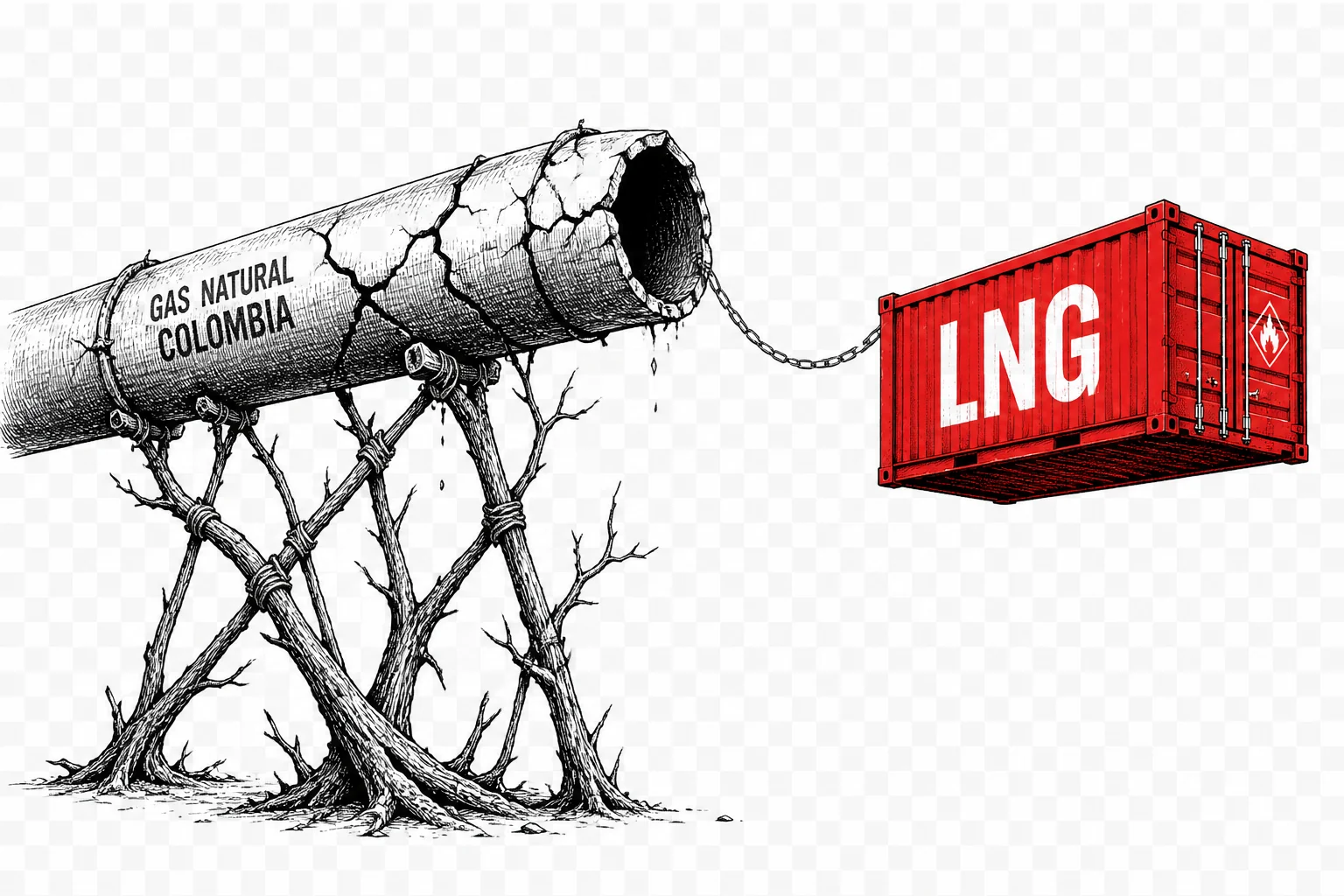
Declining Domestic Natural Gas Production in Colombia
Colombia is experiencing a notable decline in its domestic natural gas production, a trend that has significant implications for its energy landscape. Data from the Gestor del Mercado de Gas Natural en Colombia (BEC) indicates that average annual marketed natural gas output fell from 1,070 million cubic feet per day (MMcf/d) in 2022 to an estimated 772 MMcf/d in 2025. This downward trajectory continued into the first eight months of 2026, with production averaging 673 MMcf/d. The primary gas-producing fields—including Cusiana, Cupiagua, Pauto Sur, and the offshore Guajira fields—have seen sustained declines since 2022. Compounding concerns, Colombia’s proved natural gas reserves have contracted sharply by 39% to 1.7 trillion cubic feet between 2022 and 2025, according to the National Hydrocarbons Agency. The absence of significant new discoveries or developments to offset these declines presents a strategic challenge to the country’s energy self-sufficiency.
Increased Liquefied Natural Gas Imports and Infrastructure Expansion
In response to the shortfall in domestic supply, Colombia has substantially increased its imports of liquefied natural gas (LNG). By July 2026, LNG imports accounted for a record 31% of the nation’s monthly natural gas supply, highlighting a growing dependence on foreign sources. Currently, Colombia operates a single LNG import terminal, the SPEC LNG terminal near Cartagena on the Caribbean coast. Recognizing the critical role of LNG imports, the government and private sector are advancing infrastructure projects to expand import capacity. The SPEC terminal is undergoing expansion, expected to be operational by late 2026, potentially as early as October. Additionally, new terminals are in development, including the Buenaventura LNG terminal, targeting a November 2026 startup, alongside the Puerto Bahia and Ballenas LNG terminals, which could become operational in 2027. These infrastructure investments reflect strategic efforts to bolster energy supply resilience amid supply uncertainties.
El Niño’s Impact on Hydroelectric Generation and Natural Gas Demand
The energy supply challenges are further exacerbated by climatic factors. On June 11, 2026, the National Oceanic and Atmospheric Administration (NOAA) confirmed the formation of a strong El Niño event in the tropical Pacific, with forecasts indicating an over 83% probability of a strong to very strong event persisting through early 2027. El Niño phenomena typically induce drier-than-average conditions across northern South America during the December to February period, which directly affects Colombia’s hydroelectric generation capacity. Hydropower historically constitutes a dominant share of the country’s electricity supply; in 2025, it accounted for 81%, with natural gas and coal contributing 8% and 4%, respectively. However, during the last strong El Niño in early 2024, hydropower’s share declined to 55%, while natural gas-fired generation rose to 22%, and coal to 15%, reflecting a compensatory shift in the energy mix. In July 2026, hydropower’s share had already decreased to 66%, with natural gas and coal each providing 12%. Should the strong El Niño conditions persist, natural gas is poised to assume an even more critical role in Colombia’s electricity generation, increasing demand pressure on both domestic production and LNG imports.
Strategic Implications for Colombia’s Energy Security
The confluence of declining domestic natural gas production and the anticipated hydropower deficits driven by El Niño presents Colombia with a multifaceted energy security challenge. The country’s growing reliance on LNG imports underscores vulnerabilities related to external supply dependencies, particularly given the limited current import infrastructure. The ongoing expansion of LNG terminals is a strategic response aimed at mitigating these risks and ensuring continuity of power generation. However, the situation also reflects broader structural issues in Colombia’s energy sector, including the need for diversified energy sources and enhanced resilience against climatic variability. As natural gas assumes a more prominent role in the power sector, Colombia must navigate the balance between meeting immediate demand and fostering long-term sustainable energy strategies amid evolving environmental and market conditions.
Related Analysis
-
Germany’s Growing Reliance on U.S. LNG: Assessing the Strategic Risks of a New Gas Dependency
-
Europe’s Escalating Dependence on Russian LNG Amidst Looming Energy Supply Challenges
-
Petrobras Secures Long-Term LNG Supply Agreement with U.S. Producer Cheniere Energy
-
China Emerges as Dominant Buyer of Brazilian Oil Amid Iran Conflict Disruptions
Source:
EIA – Today in Energy
Can you afford not to expand abroad Talk to us, we’ll help you grow your business internationally.
Talk to us →