




Innovations in Flexible Robotics Drive Cost Efficiency
China’s robotics sector is witnessing a paradigm shift through companies like Wisson Technology, headquartered in Shenzhen. Departing from traditional robotic designs that rely on motors and gearboxes, Wisson employs 3D-printed plastics combined with pneumatic artificial muscles to power their robotic manipulators. This novel approach significantly reduces production costs, enabling the company to offer flexible robotic arms at approximately one-tenth the cost of conventional models. According to Cao Wei, an investor affiliated with Lanchi Ventures, Wisson’s flexible arms retail for about $1,400, a price point that could democratize access to advanced robotics in manufacturing and service industries.
Wisson’s technology also positions it to supply components for humanoid robots, with prototypes already delivered to international firms engaged in humanoid robot development. This capability underscores China’s growing foothold in advanced robotics, blending affordability with functional sophistication.
Cutting-Edge R&D in Humanoid Robotics
EX Robots’ new factory and R&D center exemplify China’s commitment to pushing the boundaries of robotics. The facility’s development of humanoid robots capable of nuanced facial expressions and speech articulation, enabled by numerous embedded micromotors, reflects a sophisticated integration of hardware and software. Such advancements hint at applications beyond industrial automation, extending into customer service, healthcare, and entertainment sectors.
China’s Dominance in Industrial Robotics Deployment
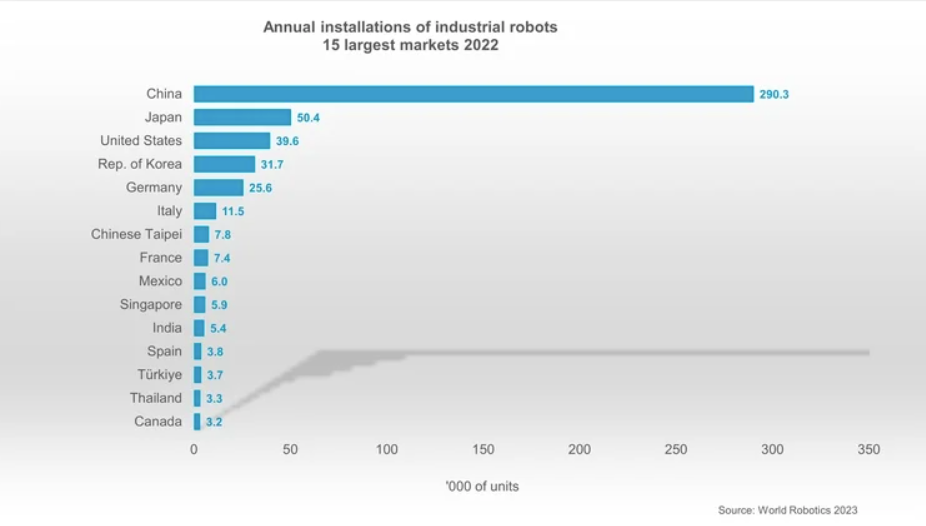
Statistical data reveals that China installs more industrial robots annually than the combined total of the next 15 largest robotics markets worldwide. This scale of deployment not only accelerates domestic automation but also establishes China as a leading market shaping global robotics trends and standards.
Advancements in Autonomous Aerial Freight
China’s innovation extends into unmanned aerial vehicles (UAVs), exemplified by the recent maiden flight of a domestically developed large twin-engine unmanned transport aircraft in Sichuan province. With a payload capacity of approximately 2,000 kilograms, a wingspan of 16.1 meters, and a height of 4.6 meters, this UAV surpasses current U.S. military equivalents in size and capability. Its spacious cargo hold of about 12 cubic meters offers versatile logistical applications, signaling China’s strategic intent to enhance autonomous freight transport capabilities.
Leadership in Generative AI Patents
China also leads globally in patent filings related to generative artificial intelligence, reflecting substantial investments in AI research and intellectual property accumulation. This patent dominance positions China to influence future AI standards and commercial applications, reinforcing its role as a key player in the evolving AI landscape.
Strategic Implications for Foreign Enterprises
The rapid pace of technological innovation and industrial scale in China presents a strategic imperative for multinational corporations. Maintaining a direct presence or close market monitoring within China is increasingly crucial to accessing cutting-edge developments, securing supply chains, and participating in emerging technology ecosystems. As China consolidates its leadership in robotics, AI, and autonomous systems, foreign firms risk falling behind if they forgo engagement with this pivotal market.
Can you afford not to expand abroad Talk to us, we’ll help you grow your business internationally.
Talk to us →