


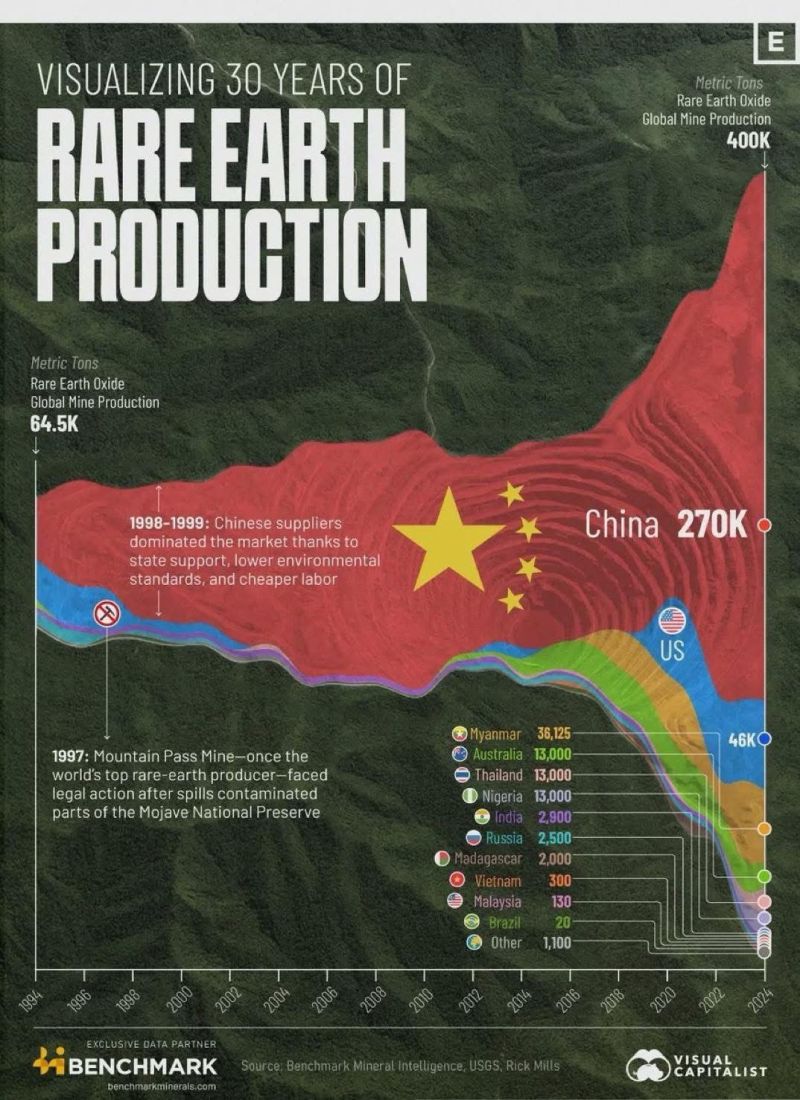
xpanding Global Production Amid China’s Dominance

Global production of rare earth elements has increased substantially from approximately 64,500 metric tons in 1994 to an estimated 400,000 metric tons in 2024. This growth reflects the rising demand for these critical minerals, which are integral to a range of advanced technologies. However, the expansion in output masks a more consequential reality: China’s overwhelming dominance in the sector. Currently, China accounts for roughly 270,000 metric tons of global production, commanding a majority share of the supply chain.
Rare Earths as Cornerstones of Emerging Technologies
Rare earth elements are foundational to modern technological ecosystems. Their unique properties make them indispensable for electric vehicles (EVs), semiconductor manufacturing, defense systems, robotics, and the artificial intelligence infrastructure that underpins the next industrial revolution. These applications highlight the minerals’ strategic importance beyond mere industrial uses, positioning them as critical enablers of technological innovation and economic competitiveness.
Geopolitical Stakes in Mineral Control
The geopolitical ramifications of China’s rare earths hegemony are profound. Control over these resources translates into significant leverage in the global technology landscape. As nations seek to secure their supply chains against disruption, the competition for access to rare earths is intensifying. The strategic calculus now extends beyond software and chip design to encompass the raw materials essential for manufacturing these technologies.
Supply Chain Security in the AI Era
In an era defined by artificial intelligence and rapid technological advancement, the security and resilience of supply chains have become as critical as technological innovation itself. The ability to maintain uninterrupted access to rare earth minerals confers a strategic advantage, influencing national security, industrial policy, and economic power. This dynamic underscores the necessity for diversified sourcing strategies and investment in alternative supply chains to mitigate dependency risks.
Ultimately, the control of rare earth elements is shaping up to be a central front in the broader competition for technological supremacy, with significant implications for global power structures and industrial capabilities.
Related Analysis
-
Kenya’s Mrima Hill Emerges as Strategic Battleground in US-China Critical Minerals Competition
-
China’s Ambition to Control High-Speed Rail via Low Earth Orbit Satellites: Strategic Implications and Cybersecurity Challenges
-
German Industry’s Strategic Stockpiling of Rare Earths Amid EU-China Trade Tensions
-
Geopolitical and Industrial Implications of ASML’s EUV Technology and U.S.-China Export Controls
-
Assessing the Limits of Export Controls on China’s Expanding Industrial Base
Source: Linkedin
Can you afford not to expand abroad Talk to us, we’ll help you grow your business internationally.
Talk to us →