


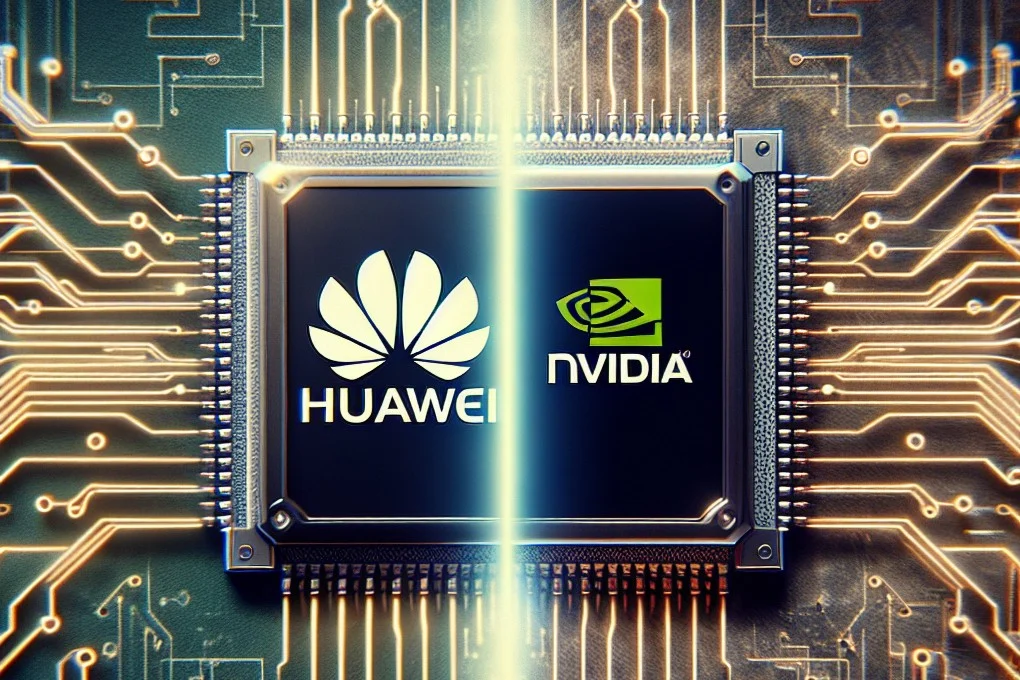
Huawei’s Technological Leap in AI Chip Performance
Recent developments in artificial intelligence hardware have placed Huawei’s CloudMatrix 384 architecture, equipped with Ascend 910C chips, at the forefront of AI computing performance. According to a technical paper co-published by Huawei and SiliconFlow, the CloudMatrix system outperforms Nvidia’s H800 GPUs in executing DeepSeek’s R1 AI model, a generative AI workload demanding high computational efficiency.
Specifically, during the prefill phase of processing a 4,000-token prompt, CloudMatrix-Infer achieves a throughput of 6,688 tokens per second per neural processing unit (NPU), with an efficiency of 4.45 tokens per second per teraflop (TFLOPS). In the decoding phase, it sustains 1,943 tokens per second per NPU, maintaining latency below 50 milliseconds and efficiency at 1.29 tokens per second per TFLOPS. These metrics surpass Nvidia’s SGLang framework running on H100 GPUs and outperform DeepSeek’s R1 executions on the H800 platform, marking a notable technological advance for Chinese AI hardware.
Architectural Innovations and Strategic Implications
The CloudMatrix 384 system integrates 384 Ascend 910C NPUs alongside 192 Kunpeng CPUs, engineered specifically to handle demanding generative AI tasks similar to those executed by models like ChatGPT. Huawei’s CEO, Ren Zhengfei, has acknowledged that while individual Ascend 910C chips lag behind Nvidia’s latest offerings on a per-chip basis, the company compensates through architectural strategies such as stacking and clustering, enabling collective performance that rivals or exceeds competitors.
Jensen Huang, Nvidia’s CEO, has also recognized the scale and energy efficiency advantages that China’s semiconductor ecosystem can leverage, highlighting the strategic depth behind Huawei’s approach. For Huawei, operating under stringent international sanctions, this achievement underscores a capacity for innovation and resilience that challenges assumptions about technological dependency and supply chain vulnerabilities.
Broader Market and Geopolitical Context
Huawei’s success with the R1 model, which comprises 671 billion parameters, running more efficiently on its proprietary hardware than on restricted Nvidia platforms, signals a maturation of China’s AI ecosystem. This progress is particularly significant given the global AI market’s projected growth to $1 trillion by 2030, positioning China as a formidable competitor in AI hardware and software development.
For European companies, especially those in Germany’s semiconductor, cloud computing, and AI software sectors, Huawei’s advancements open avenues for strategic collaboration. Industry experts suggest that partnerships with Chinese cloud providers could reduce development costs and accelerate innovation. Establishing localized teams in technology hubs such as Shanghai to monitor trends and foster joint ventures could serve as a pragmatic entry point into this dynamic market.
Strategic Considerations Amid Regulatory and Geopolitical Challenges
Despite the promising technology landscape, companies must navigate complex regulatory and geopolitical environments in China. A measured approach, beginning with comprehensive market studies to assess risks and opportunities, is advisable. Huawei’s breakthrough exemplifies how innovation can transcend geopolitical barriers, emphasizing the importance for global firms to engage thoughtfully with emerging technological ecosystems to maintain competitiveness in the evolving AI landscape.
Can you afford not to expand abroad Talk to us, we’ll help you grow your business internationally.
Talk to us →